Seminár detašovaného pracoviska Matematického ústavu SAV v Košiciach
| najbližšie: | |
| 8. 10. 2026 | Galina Jirásková |
| predchádzajúce: |
| 8. 1. 2026 | Simon Dieck (Delft University of Technology) – Automata learning algorithms obtained from Myhill-Nerode-style theorems |
| odkaz na prezentáciu | |
| 22. 1. 2026 | Irena Jadlovská – Poznámka k riešeniu 3D diskrétnych slabo oneskorených systémov |
|
Abstrakt: Diskutujeme efektívne využitie Putzerovho algoritmu pri riešení trojrozmerných
diskrétnych slabo oneskorených (WD) systémov, ako sú definované v [1].
Konkrétne ukážeme, ako možno mocniny rozšírenej $(3m+1)×(3m+1)$ matice $\mathcal A$ vyjadriť pomocou jednoduchej rekurzie,
ktorá zahŕňa iba matice rozmeru $3\times 3$.
[1] Diblík, Josef, et al. „General solutions of weakly delayed discrete systems in 3D.” Advances in Nonlinear Analysis 14.1 (2025): 20250121. |
|
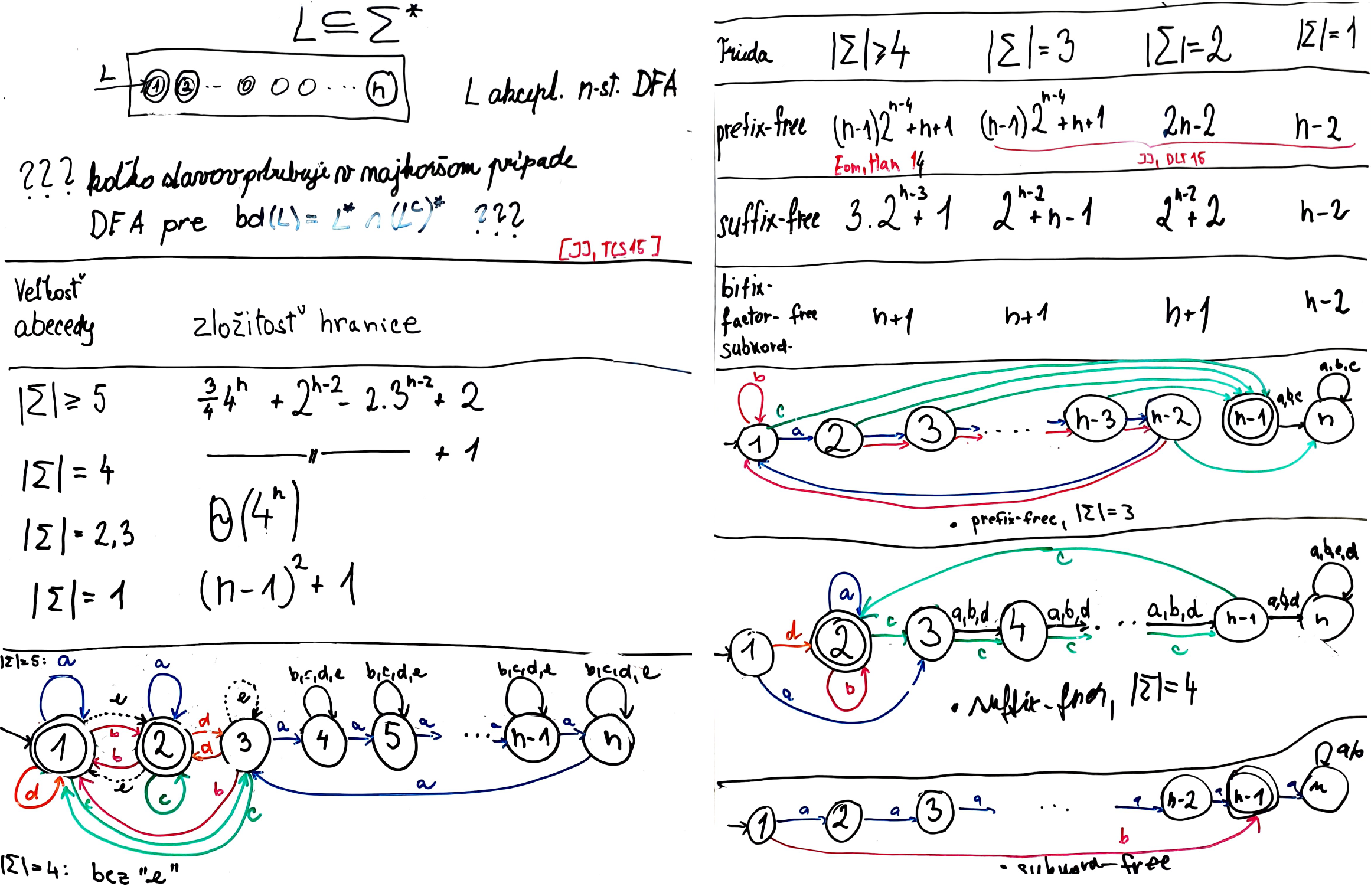
| 12. 2. 2026 | Galina Jirásková – Hranica na "free" konvexných jazykoch |
|
Abstrakt: Prezentujeme úplné riešenie problému určenia deterministickej stavovej zložitosti
operácie hranica na triedach jazykov neobsahujúcich predpony, prípony, predpony a prípony, faktory, a podslová ("free" konvexné jazyky).
odkaz na fotku s riešením |
|
| 26. 2. 2026 | Miroslav Repický – Kombinatorické vlastnosti ideálov |
| Abstrakt: $\newcommand{\Iwf}{\mathcal{I}} \newcommand{\Zwf}{\mathcal{Z}} \newcommand{\Swf}{\mathcal{S}} \newcommand{\cov}{\mathrm{cov}}$ Zaoberáme sa kardinálnou charakteristikou $\cov^*(\Iwf)$ pre ideál množín nulovej hustoty $\Zwf$, sumovateľný ideál $\Iwf_{1/n}$ a pre zovšeobecnenia $\Zwf(\bar I)$ a $\Swf(\bar I)$ týchto ideálov závislých na intervalovom rozklade $\bar I$ množiny prirodzených čísel. Máme charakterizácie inklúzií $\Zwf(\bar I)\subseteq\Zwf$, $\Zwf(\bar I)\supseteq\Zwf$, $\Swf(\bar I)\subseteq\Iwf_{1/n}$, $\Swf(\bar I)\supseteq\Iwf_{1/n}$ pomocou jednoduchých vlastností rozkladu~$\bar I$ a ukazujeme, že relačné štruktúry súvisiace s kardinálnou charakteristikou $\cov^*(\Iwf)$ pre tieto ideály majú svoje ekvivalentné vyjadrenia v zmysle Tukeyovských konexií v tvare pseudo-lokalizácií funkcií. | |
| 12. 3. 2026 | Jozef Pócs – Charakterizácia Archimedovkých $t$-noriem, ktoré sú 2-D lineárnymi spline-ami. |
| Abstrakt: Je známe, že každú spojitú Archimedovskú $t$-normu je možné popísať pomocou aditívneho generátora. Taktiež je známe, že v prípade ak aditívny generátor je tzv. 1-D lineárny spline, tak výsledná $t$-norma je 2-D lineárny spline. V našom príspevku ukážeme, že platí aj opačná implikácia, t.j. ak Archimedovská $t$-norma je 2-D lineárny spline, tak príslušný aditívny generátor je 1-D lineárny spline. | |
| 26. 3. 2026 | Peter Eliaš – Matematická taxonómia, množinová reprezentácia ortoposetov a konštrukcia voľných ortomodulárnych posetov nad ortoposetmi |
| Abstrakt: V práci [1] bola formulovaná takáto úloha: popísať všetky "klasifikácie", t.j. zoznamy vlastností (otázok s odpoveďami áno-nie), ktoré umožňujú klasifikovať jedince do $n$ rôznych druhov. V práci [2] bola táto otázka riešená kombinatoricky a boli nájdené všetky klasifikácie pre nanajvýš 7 druhov. Neskôr bolo dokázané, že počet optimálnych klasifikácií $n$ druhov zodpovedá počtu stromov (neorientovaných acyklických grafov) s $n$ vrcholmi. | |
| Pozorovania na malom počte vrcholov ukázali, že počet súvislých ortoposetov s $2n$ prvkami zodpovedá počtu stromov s $n$ vrcholmi. Porovnanie s "klasifikáciami" motivovalo formuláciu nasledovných tvrdení, ktoré sme dokázali: | |
| 1. Ak $X$ je neprázdna množina a $\mathcal{S}\subseteq\mathcal{P}(X)$ je systém množín uzavretý na komplementy, tak $(\mathcal{S},\subseteq,{}^c)$ je ortoposet. 2. Ak $P$ je ortoposet a $\mathcal{I}$ je systém všetkých ideálov na $P$, tak $P$ je izomorfný so systémom množín $\mathcal{S}_P=\{\{I\in\mathcal{I}\colon x\notin I\}\colon x\in P\}$. 3. Ak $P$ je ortoposet, tak voľný ortomodulárny poset nad $P$ je izomorfný s uzáverom systému $\mathcal{S}_P$ na disjunktné zjednotenia (pri zachovaní uzavretosti na komplementy). | |
| [1] Wexler, P. J., On the number of taxonomies, or the odds of 'structuralism', American Anthropologist, vol. 73 (1971), 1258. [2] Wexler P. J, Fremlin D. H., The number of classifications up to seven classificanda, Classification Society Bulletin, vol. 4, no. 3, (1979). | |
| 23. 4. 2026 | Ján Haluška – Od systému 12-TET k lineárnej variete usporiadaných komutatívnych algebier $\mathscr{W}_{12}$ pri píšťalových organoch |
| Abstrakt: Všetky objekty v tejto práci sú objekty veľmi komplexnej povahy (psychicko-akustickej, matematickej, fyzikálnej, materiálovej, technickej, duchovnej, historickej, hudobníckej, atď.). Matematicky platia s istou dopredu známou presnosťou, ktorá nevybočuje zo stanovených kompromisných koridorov. Silne uspokojujúcim faktom potvrdzujúcim správnosť teórie je tzv. kritérium praxe. Nasledovné tri psychologické fenomény, na ktorých je založený súčasný 12-tónový rovnomerne temperovaný systém (12-TET), sú podstatné aj ohľadom píšťalových registrov. Sú to: Pytagorejská koma, Oktávová ekvivalencia a rovnaká hudobná farba (timbre) všetkých tónov. | |
| 7. 5. 2026 | Anna Derevianko (VUT Brno) – On control of 2D switched system by means of geometric algebra for conics. |
| Abstrakt: The controllability of 2x2 switched systems with regular matrices is investigated by means of Geometric Algebra for Conics (GAC) as a mathematical framework for analysis and optimization of control strategies. The research demonstrates the efficiency of GAC in the construction of switching points and paths while minimizing the number of switches and numerical errors. Classification of controllability is provided based on the geometric properties of particular switched systems. For controllable switched systems, the controlling algorithm based on the GAC primitives is introduced in which the symbolic algebra operations are used, more precisely the wedge and inner product. Therefore, no numerical solver to the system of equations is needed. Indeed, the only operation that may bring in a numerical error is a vector normalisation, ie., square root calculation. The proposed approach creates possibility of passing from the classical solution of the controllability problem for switched systems to a geometric one, based on the type of phase trajectory. | |
| 21. 5. 2026 | Lenka Macálková (VUT Brno) – Weakly delayed planar linear differential systems |
| Abstrakt: The talk studies weakly delayed planar linear differential systems with constant matrices and two constant delays. The definition of weakly delayed systems is analysed, and the coefficient criteria for the matrix entries ensuring that the system is weakly delayed are derived in two cases: when one is double the first, and when it is not. Explicit formulas for the solution to the initial problem and for the general solution are discussed in terms of the eigenvalues of the matrix of non- delayed terms. It is shown that, once the transient interval has passed, the behaviour of the solutions becomes a linear combination of two exponential-type functions. The majority of the results are achieved using the Laplace transform technique. | |
| Josef Diblík (VUT Brno) – Weakly delayed discrete and differential systems | |
| Abstrakt: The talk is a follow-up to the previous one discussing weakly delayed planar linear differential systems and presenting the conditions for merging the solutions defined by different initial functions. Moreover, some aspects of weakly delayed planar linear non-differential (discrete) systems with two delayes will be considered. It will be shown that the set of weakly delayed non- differential systems is much richer than that of weakly delayed differential systems. Also the differences will be emphasized between the definitions of weakly delayed differential and difference systems. Finally, some perspectives will be outlined concerning the cooperation with the Košice branch of SAV in investigating weakly delayed differential and discrete systems. | |
| 11. 6. 2026 | Emília Halušková – O algebre určenej po častiach lineárnou funkciou na intervale |
|
Abstrakt:
Nech $T$ je interval reálnych čísel $[0,1)$.
Uvažujme nasledujúcu funkciu $f\colon T\to T$
\[
f(x)=\begin{cases}
2x & 0\le x<\frac{1}{2},\\
-3x+2 & \frac{1}{2}\le x<\frac{2}{3},\\
3x-2 & \frac{2}{3}\le x<1.
\end{cases}
\]
Dvojica $(T,f)$ je monounárna algebra.
Vyšetrujeme štruktúru tejto algebry, pretože nás o to požiadal prof. T. Kalmár-Nagy z Technickej a ekonomickej univerzity v Budapešti.
Nech $n$ je a prirodzené číslo. Algebra $(T,f)$ obsahuje cyklus dĺžky $n$. Našli sme všetky prvky $T$, ktoré patria do $n$-prvkových cyklov $(T,f)$. Použili sme tu indexovanie prvkov pomocou slov nad abecedou $\{ 0,1,2\}$ a Lyndon--Schützenbergerovu vetu z teórie automatov. Každý súvislý komponent $(T,f)$ s cyklom je tvorený racionálnymi číslami. Zatiaľ nie je známe, či každé racionálne číslo patrí do komponentu $(T,f)$ s cyklom. Táto práca je spoločná s Petrom Eliašom a Radkou Schwartzovou. |
|
| 24. 6. 2026 | Michal Hospodár – Rozsah akceptačných stavových zložitostí pre proporčné odstránenie a pridanie na podtriedach regulárnych jazykov |
| Abstrakt: Operácie proporčného odstránenia a proporčného pridania boli skúmané z pohľadu obyčajnej aj nedeterministickej stavovej zložitosti. My sa pozrieme na akceptačnú stavovú zložitosť proporčného odstránenia, a to na viacerých podtriedach regulárnych jazykov. Zistíme, že pre grupové jazyky sa dosahuje celá množina prirodzených čísel pomocou binárnej abecedy, zatiaľ čo pre konečné jazyky sa celá množina prirodzených čísel dosahuje s použitím rastúcej abecedy. V unárnom prípade sa dosahuje iba interval od $0$ do $n$. Na druhej strane, proporčné pridanie nezachováva regulárnosť vo všeobecnosti, ale zachováva ju v podtriedach konečných jazykov a jazykov s konečným doplnkom. | |
| 24. 9. 2026 | Irena Jadlovská – O ostrom kritériu pre vlastnosť A diferenciálnych rovníc vyššieho rádu s oneskorením |
|
Abstrakt:
V prednáške je diskutovaný ostrý kvalitatívny výsledok pre lineárnu diferenciálnu rovnicu
s oneskorením n-tého rádu a jeho aplikácie. Prístup je založený na metóde iteračnej konštrukcie
ostrých dolných a horných apriórnych odhadov kladných riešení z triedy $\mathcal{N}_{\ell}$,
v zmysle známej Kiguradzeho klasifikácie. Získaný výsledok vychádza z práce
Koplatadze, R., G. Kvinikadze, and I. P. Stavroulakis. "Properties and of th-order linear differential equations with deviating argument." Georgian Mathematical Journal 6.6 (1999): 553-566. |