Seminar of the Extension of the Mathematical Institute SAS in Košice
| next: | |
| 8. 10. 2026 | Galina Jirásková |
| previous: | |
| 8. 1. 2026 | Simon Dieck (Delft University of Technology) – Automata learning algorithms obtained from Myhill-Nerode-style theorems |
| link to slides | |
| 22. 1. 2026 | Irena Jadlovská – A note on solving 3D discrete weakly delayed systems |
|
Abstract:
We discuss the effective application of Putzer’s algorithm to the solution of three-dimensional discrete weakly delayed (WD) systems,
as defined in [1]. In particular, we show how the powers of the augmented $(3m+1)\times(3m+1)$ matrix $\mathcal A$
can be computed through a simple recursion involving only $3\times3$ matrices.
[1] Diblík, Josef, et al. "General solutions of weakly delayed discrete systems in 3D." Advances in Nonlinear Analysis 14.1 (2025): 20250121. |
|
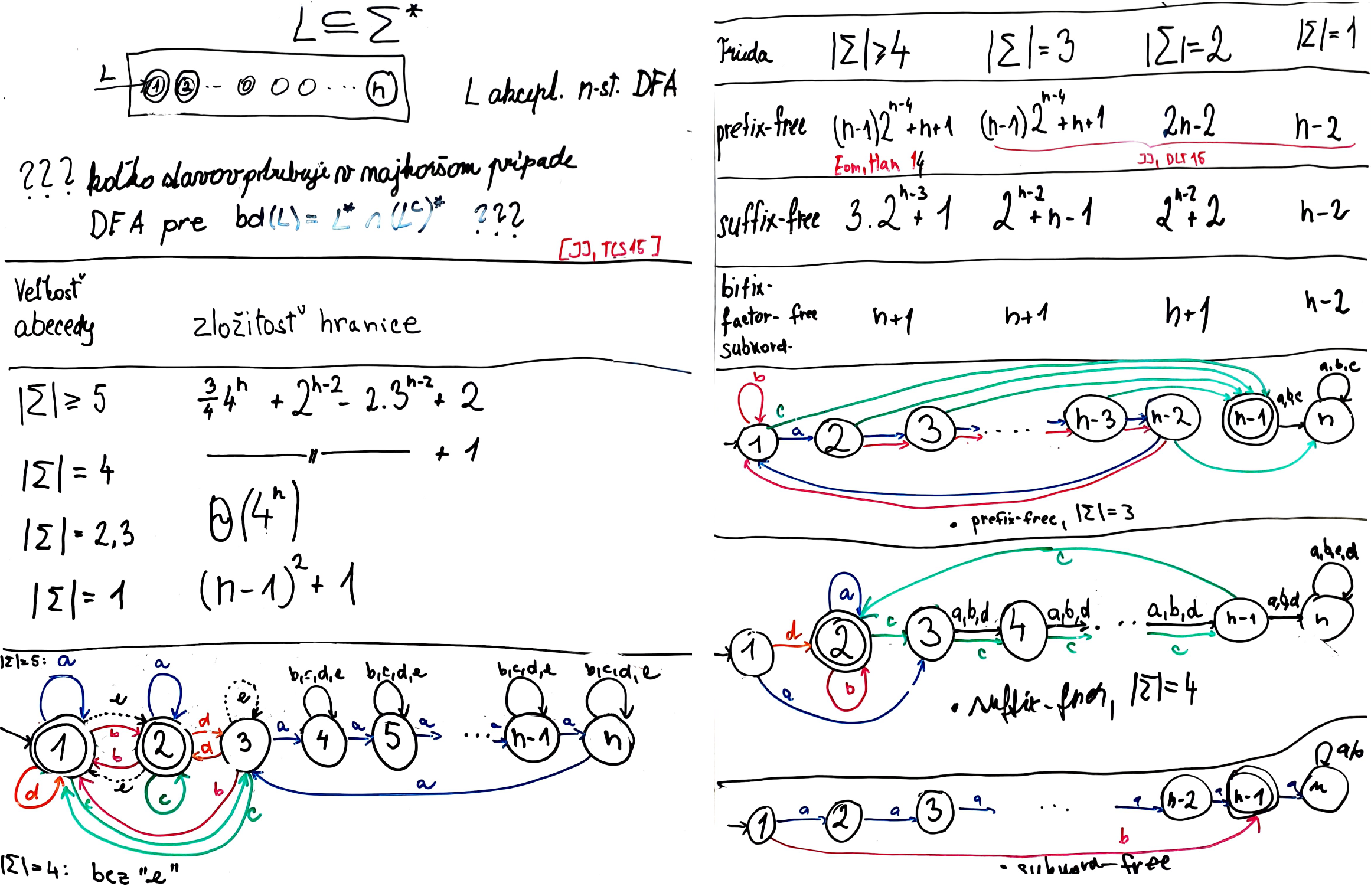
| 12. 2. 2026 | Galina Jirásková – The boundary of free convex languages |
|
Abstract: We present a complete solution of the problem of finding
the deterministic state complexity of the boundary operation on the classes of
prefix-free, suffix-free, bifix-free, factor-free, and subword-free languages.
link to photo with the solution |
|
| 26. 2. 2026 | Miroslav Repický – Combinatorial properties of ideals |
| Abstract: We deal with the cardinal characteristics $\mathrm{cov}^*(\mathcal{I})$ for the ideal $\mathcal{Z}$ of zero-density sets, the summable ideal $\mathcal{I}_{1/n}$, and for the generalizations $\mathcal{I}(\bar I)$ and $\mathcal{S}(\bar I)$ of these ideals dependent on an interval partition $\bar I$ of the set of natural numbers. We have characterizations of the inclusions $\mathcal{Z}(\bar I)\subseteq\mathcal{Z}$, $\mathcal{Z}(\bar I)\supseteq\mathcal{Z}$, $\mathcal{S}(\bar I)\subseteq\mathcal{I}_{1/n}$, $\mathcal{S}(\bar I)\supseteq\mathcal{I}_{1/n}$ using simple properties of the partition $\bar I$, and we show that the relational structures related to the cardinal characteristics of $\mathrm{cov}^*(\mathcal{I})$ for these ideals have their equivalent expressions in the sense of Tukey-connections in the form of pseudo-localizations of functions. | |
| 12. 3. 2026 | Jozef Pócs – Characterization of Archimedean $t$-norms, which are 2-D linear splines. |
| Abstract: It is known that every continuous Archimedean $t$-norm can be described using an additive generator. It is also known that if the additive generator is a so-called 1-D linear spline, then the resulting $t$-norm is a 2-D linear spline. We will show that the converse implication also holds, i.e., if an Archimedean $t$-norm is a 2-D linear spline, then the corresponding additive generator is a 1-D linear spline. | |
| 26. 3. 2026 | Peter Eliaš – Matematical taxonomy, set representations of orthoposets, and free orthomodular posets over orthoposets |
| Abstract: In [1], the following problem was formulated: to describe all "classifications", that is lists of properties that allow to classificate individuals into $n$ classes or species. In [2], this question was addressed combinatorially and all classifications for up to 7 classes were found. Later it was proved that the number of optimal classifications of $n$ species corresponds to the number of trees (unoriented acyclic graphs) with $n$ vertices. | |
| Our observations for small number of elements revealed that the number of connected orthoposets with $2n$ elements corresponds to the number of trees with $n$ vertices. The connection to "classifications" motivated us to formulate and prove the following results: | |
| 1. If $X$ is a nonempty set and $\mathcal{S}\subseteq\mathcal{P}(X)$ is a complement-closed family of subsets then $(\mathcal{S},\subseteq,{}^c)$ is an orthoposet. 2. If $P$ is an orthoposet and $\mathcal{I}$ is the family of all ideals on $P$ then $P$ is isomorphic to the family $\mathcal{S}_P=\{\{I\in\mathcal{I}\colon x\notin I\}\colon x\in P\}$. 3. If $P$ is an orthoposet then the free orthomodularny poset over $P$ is isomorphic to the closure of $\mathcal{S}_P$ under disjoint unions (while preserving the property of being closed under complements). | |
| [1] Wexler, P. J., On the number of taxonomies, or the odds of 'structuralism', American Anthropologist, vol. 73 (1971), 1258. [2] Wexler P. J, Fremlin D. H., The number of classifications up to seven classificanda, Classification Society Bulletin, vol. 4, no. 3, (1979). | |
| 23. 4. 2026 | Ján Haluška – From the system 12-TET to a linear variety of ordered commutative algebras $\mathscr{W}_{12}$ for pipe organs |
| Abstract: All objects in this paper are objects of a great complex nature (psycho-acoustical, mathematical, physical, fyzikálnej, material, spiritual, historical, musician, etc.). They hold mathematicaly with respect to any certainty in advance, which does does not turn out of the predetermined compromise corridors. A very satisfying fact confirming the correctness of the theory is the so-called practice criterion. Concerning organ stops, there are three psychological phenomena on which is based the present tone system 12-tone equal temperament (12-TET). They are: Pythagorean Comma, Octave Equivalence, and Equal Timbre of all tones in a stop. | |
| 7. 5. 2026 | Anna Derevianko (VUT Brno) – On control of 2D switched system by means of geometric algebra for conics. |
| Abstract: The controllability of 2x2 switched systems with regular matrices is investigated by means of Geometric Algebra for Conics (GAC) as a mathematical framework for analysis and optimization of control strategies. The research demonstrates the efficiency of GAC in the construction of switching points and paths while minimizing the number of switches and numerical errors. Classification of controllability is provided based on the geometric properties of particular switched systems. For controllable switched systems, the controlling algorithm based on the GAC primitives is introduced in which the symbolic algebra operations are used, more precisely the wedge and inner product. Therefore, no numerical solver to the system of equations is needed. Indeed, the only operation that may bring in a numerical error is a vector normalisation, ie., square root calculation. The proposed approach creates possibility of passing from the classical solution of the controllability problem for switched systems to a geometric one, based on the type of phase trajectory. | |
| 21. 5. 2026 | Lenka Macálková (VUT Brno) – Weakly delayed planar linear differential systems |
| Abstract: The talk studies weakly delayed planar linear differential systems with constant matrices and two constant delays. The definition of weakly delayed systems is analysed, and the coefficient criteria for the matrix entries ensuring that the system is weakly delayed are derived in two cases: when one is double the first, and when it is not. Explicit formulas for the solution to the initial problem and for the general solution are discussed in terms of the eigenvalues of the matrix of non- delayed terms. It is shown that, once the transient interval has passed, the behaviour of the solutions becomes a linear combination of two exponential-type functions. The majority of the results are achieved using the Laplace transform technique. | |
| Josef Diblík (VUT Brno) – Weakly delayed discrete and differential systems | |
| Abstract: The talk is a follow-up to the previous one discussing weakly delayed planar linear differential systems and presenting the conditions for merging the solutions defined by different initial functions. Moreover, some aspects of weakly delayed planar linear non-differential (discrete) systems with two delayes will be considered. It will be shown that the set of weakly delayed non- differential systems is much richer than that of weakly delayed differential systems. Also the differences will be emphasized between the definitions of weakly delayed differential and difference systems. Finally, some perspectives will be outlined concerning the cooperation with the Košice branch of SAV in investigating weakly delayed differential and discrete systems. | |
| 11. 6. 2026 | Emília Halušková – On an algebra determined by a piecewise linear function on the interval |
|
Abstract:
Denote by $T$ the interval of real numbers $[0,1)$.
Consider the following function $f\colon T\to T$
\[
f(x)=\begin{cases}
2x & 0\le x<\frac{1}{2},\\
-3x+2 & \frac{1}{2}\le x<\frac{2}{3},\\
3x-2 & \frac{2}{3}\le x<1.
\end{cases}
\]
The couple $(T,f)$ is a monounary algebra.
We deal with a structure of this algebra since prof. T. Kalmár-Nagy from Budapest University of Technology and Economics asks for it.
Let $n$ be a natural number. It turns out that $(T,f)$ contains a cycle of length $n$. We describe all elements which belong to an $n$-element cycle of $(T,f)$. We used here the indexing of elements by words over the alphabet $\{ 0,1,2\}$ and Lyndon--Schützenberger Theorem from Automata Theory. Every connected component of $(T,f)$ with a cycle consists of rationals. It is not known whether there is a rational number in a component without a cycle. This is a joint work with Peter Eliaš and Radka Schwartzová. |
|
| 24. 6. 2026 | Michal Hospodár – Accepting-state spectrum of proportional removals and additions on subregular language classes |
| Abstract: The operations of proportional removal and proportional addition were examined from the point of view of both ordinary and nondeterministic state complexity. We look at the accepting state complexity of proportional removal, considering several subclasses of regular languages. We found out that for group languages, the set of nonnegative integers is attained using binary languages, while for finite languages, this set is attained using a growing alphabet. In the unary case, only the interval from $0$ to $n$ is attained. On the other hand, proportional addition does not preserve regularity in general, but it does preserve it in finite and co-finite languages. | |
| 24. 9. 2026 | Irena Jadlovská – On a sharp criterion for Property A to higher-order delay differential equations |
|
Abstract:
In the given talk, a sharp oscillation result for an $n$-th order linear delay differential equation is present,
together with several applications. The approach is based on an iterative construction of sharp
lower and upper a priori estimates for a positive solution belonging to the class $\mathcal{N}_{\ell}$,
in the sense of the well known Kiguradze classification. The obtain result builds on the work
Koplatadze, R., G. Kvinikadze, and I. P. Stavroulakis. "Properties and of th-order linear differential equations with deviating argument." Georgian Mathematical Journal 6.6 (1999): 553-566. |